/ MBD Blog
MENU

Learn how ecommerce brands can improve AI visibility, GEO performance and AI recommendations across ChatGPT, Gemini, Perplexity and AI-powered search experiences.


Who Is This Article For? This guide is for ecommerce leaders, marketers and business owners who want to understand how AI search is changing online visibility — and what it means for their brand.
If you're already investing in SEO, content and growth, you've probably noticed something changing.
Customers are no longer relying solely on Google to discover products, compare options or evaluate brands. Increasingly, they are turning to AI assistants such as ChatGPT, Gemini, Perplexity and Claude to help them make decisions.
Before we dive in, it's worth clarifying three terms that appear throughout this guide.
Think of it this way: SEO is the foundation. GEO is the optimisation process. AI Visibility is the result.
For more than two decades, search followed a familiar pattern.
A user entered a query, a search engine returned a list of links, and the user decided which website deserved their attention.
The brands that ranked highest received the most visibility. The brands that earned the click had the opportunity to tell their story, demonstrate value and convert visitors into customers.
Today, that journey is changing.
Instead of presenting ten blue links, AI systems increasingly provide direct answers.
When someone asks: "What are the best office chairs for remote work?" or "Which skincare brands are best for sensitive skin?" they often receive a curated answer before visiting a single website.
The decision-making process is moving from the search results page into the answer itself. For ecommerce brands, that changes the rules of visibility. Rankings still matter, but they are no longer the whole story. Increasingly, visibility depends on whether AI systems understand, trust and recommend your brand.
Most online purchases begin with a question. Increasingly, AI systems are helping customers answer those questions before they visit a website.
For ecommerce brands, this creates a new reality. Visibility is no longer determined solely by rankings. It depends on whether AI systems understand your brand, trust your information and include you in their recommendations.
One of the biggest sources of confusion today is terminology. Terms such as AI SEO, GEO, AI search optimisation, LLM SEO and AI visibility are often used interchangeably, creating the impression that they describe different strategies.
In reality, they are different ways of describing the same evolution. As search moves beyond rankings and links, brands need a framework for understanding how AI systems discover, interpret and recommend information. These terms simply focus on different parts of that process.
Search Engine Optimisation (SEO) focuses on improving visibility within traditional search engines such as Google. The goal is to help search engines understand your content and rank it for relevant searches, making it easier for potential customers to discover your brand.
Success is typically measured through metrics such as:
SEO remains the foundation of online visibility. Without strong technical SEO, content quality and authority signals, most brands will struggle to build sustainable discoverability across both traditional search and emerging AI-powered experiences.
Generative Engine Optimisation (GEO) focuses on improving how AI systems understand, reference and recommend a brand. Rather than optimising for rankings, GEO focuses on increasing the likelihood that a brand will be included in AI-generated answers and recommendations.
The objective is to help platforms such as ChatGPT, Gemini, Perplexity and Claude:
Unlike traditional SEO, GEO is not measured by rankings alone. It is measured by visibility within AI-generated responses and the frequency with which a brand appears in recommendations.
In practice, GEO builds on SEO rather than replacing it. Strong SEO foundations remain essential because AI systems often rely on the same content, authority signals and structured information that help search engines understand a brand.
Throughout this article, we use the term AI SEO because it is the language most marketers, ecommerce teams and business leaders recognise today.
Strictly speaking, many of the strategies discussed fall under Generative Engine Optimisation (GEO) — the practice of improving how AI systems understand, reference and recommend a brand. However, from a business perspective, the terminology matters less than the outcome.
Whether you call it AI SEO or GEO, the objective remains the same: helping your brand become more visible within AI-powered search experiences and recommendation systems.
If SEO is the foundation and GEO is the process, then AI Visibility is the outcome.
At its core, AI Visibility answers a practical business question:
How often do AI systems recommend your brand when potential customers are looking for the products, services or solutions you provide?
This is where optimisation becomes measurable. Instead of focusing solely on rankings and traffic, brands can evaluate whether they are actually appearing within AI-generated answers and recommendations.
Key questions include:
For ecommerce brands, AI Visibility is becoming an increasingly important performance metric alongside rankings, organic traffic and conversions. It provides a clearer picture of how discoverable a brand is within the growing ecosystem of AI-powered search and recommendation platforms.
Google maintains that the foundations remain the same: helpful content, strong technical SEO and trustworthy information. However, AI visibility extends beyond Google. Platforms such as ChatGPT, Perplexity and Claude evaluate information differently, which is why GEO is becoming an increasingly important layer of modern search strategy.
Search hasn't disappeared. It has evolved.
Customers still have questions. They still need information, context and confidence before making a purchase. The difference is that AI systems are becoming active participants in that decision-making process.
Instead of simply directing users towards information, AI increasingly interprets that information on their behalf. As a result, visibility is no longer shaped solely by rankings and clicks. It is increasingly influenced by whether AI systems understand, trust and recommend a brand.
That changes how ecommerce businesses need to think about optimisation.
The question is no longer:
"Can customers find us?"
It's:
"When AI helps customers make decisions, will our brand be part of the answer?"
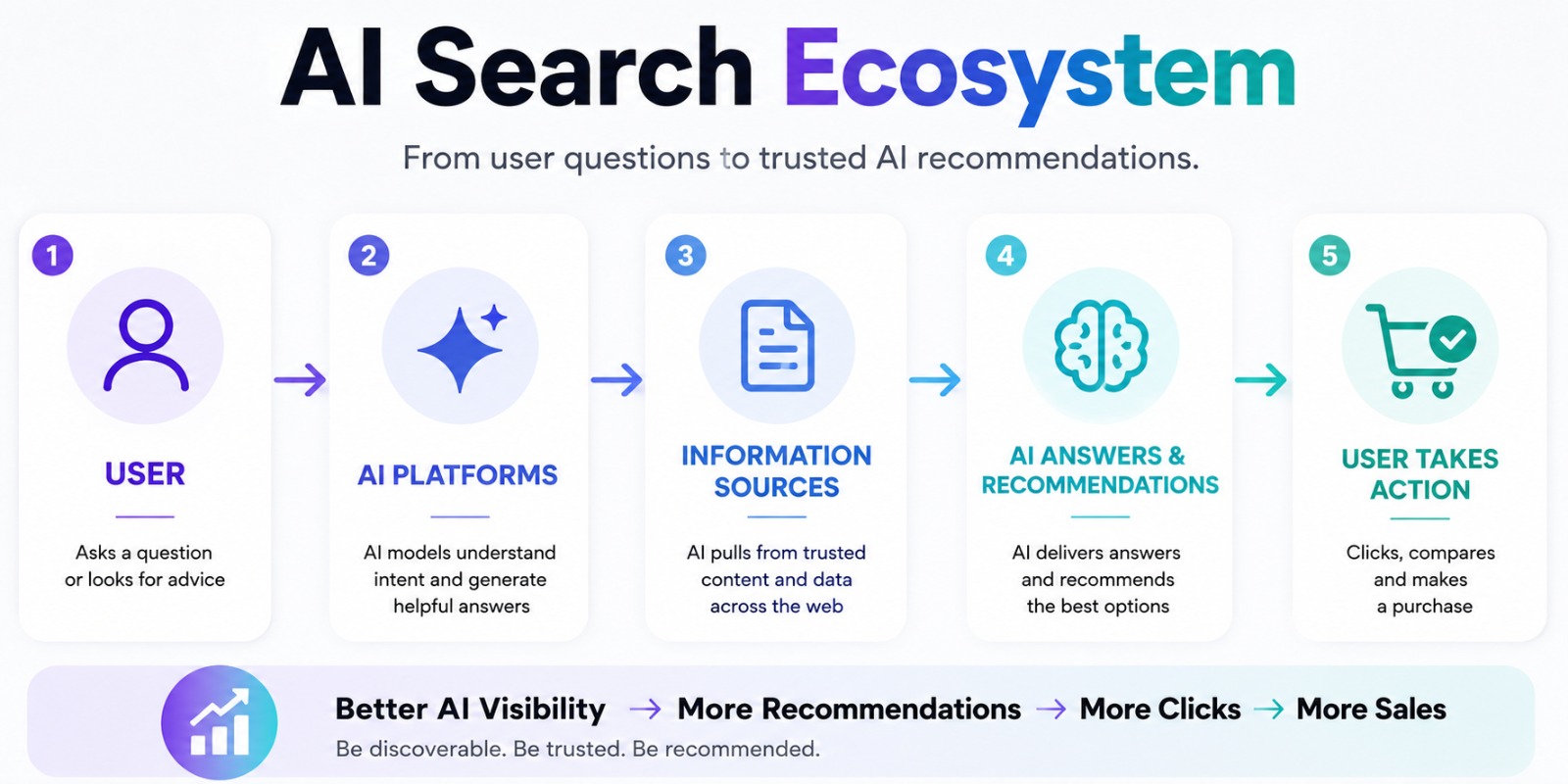
To understand how ecommerce brands can improve AI visibility, it's important to understand what has changed behind the scenes.
Many businesses still view AI search as an extension of traditional search. In reality, AI-powered answer engines operate differently. While both help users find information, they don't follow the same decision-making process.
This distinction matters because it changes how brands are discovered, evaluated and ultimately recommended. Visibility is no longer determined solely by where a page ranks. Increasingly, it depends on how effectively AI systems can interpret, trust and surface information in response to a user's question.
For years, search followed a relatively straightforward process. A user entered a query, Google analysed billions of pages, identified the most relevant results and presented them in ranked order. The user's role was then to evaluate those results and decide which links deserved attention.
In this model, success largely depended on three factors.
Search engines continuously discover, analyse and store information from websites. The better a page is structured, optimised and connected within a website, the easier it becomes for search engines to understand and index that content.
As a result, well-optimised pages are more likely to appear for relevant searches and attract organic traffic.
Links acted as votes of confidence. When trusted websites referenced a page, search engines interpreted those links as signals of credibility, relevance and expertise. Over time, this became one of the foundations of modern SEO and a key factor in determining which pages deserved greater visibility.
As a result, websites with stronger authority signals were more likely to rank prominently and attract organic traffic.
Search engines presented options, but users made the final decision. Every click, visit and engagement signal provided additional insight into which results were most useful and relevant for a particular query.
As a result, search engines continuously refined rankings based on how users interacted with search results.
Google's role was to organise information and direct users towards relevant sources rather than interpret information or make recommendations on their behalf.
The user remained responsible for evaluating options, comparing sources and making a decision.
Users are becoming increasingly comfortable asking complex, conversational questions.
Instead of searching: "best standing desk"
they ask:"What is the best standing desk for someone who works from home and has back pain?"
Instead of searching: "running shoes review"
they ask: "Which running shoes are best for marathon training if I overpronate?"
These queries require more than simple information retrieval. They require context, interpretation and an understanding of intent — areas where AI systems excel.
Rather than returning a list of links, AI systems attempt to understand the question, evaluate relevant information and generate a direct response.
As a result, the role of search is shifting from information discovery to answer generation and recommendation.
AI Search and Answer Engines represent a new type of search experience. Rather than simply helping users navigate information, they increasingly help users interpret it.
Platforms such as ChatGPT, Gemini, Perplexity and Microsoft Copilot analyse information from multiple sources, identify relevant context and generate a synthesised response. From the user's perspective, the experience feels less like using a traditional search engine and more like consulting a knowledgeable advisor.
In most cases, the process follows a similar pattern:
The key difference is that users often receive a conclusion before visiting a website.
As a result, visibility is no longer determined solely by whether a page appears in search results, but by whether a brand becomes part of the answer itself.
In traditional search, success largely depended on rankings. In AI-powered search experiences, success increasingly depends on recommendations.
Users may never see ten competing websites. Instead, they might receive a shortlist of suggested brands, a handful of recommended products or a single preferred solution. The decision-making process begins before they visit a website.
This changes the competitive landscape significantly. Previously, appearing on the first page of search results created an opportunity to earn attention. Today, appearing within the answer creates influence.
For ecommerce brands, this distinction matters. A website can rank well in Google and still be absent from AI-generated recommendations. Conversely, a brand with modest search visibility may appear regularly in AI answers if it demonstrates strong authority, well-structured information and clear entity signals.
As a result, optimisation is no longer focused solely on rankings. It increasingly focuses on becoming a brand that AI systems can confidently recommend.
While AI platforms differ in how they operate, most visibility opportunities fall into three connected layers: LLM Visibility, Generative Search and Answer Engines.
The first layer is LLM Visibility — how well AI models recognise and understand your brand.
The core question is simple: When someone asks about your category, does the model know your brand exists? If the answer is no, recommendation becomes impossible.
LLM Visibility is influenced by factors such as:
Before AI can recommend a brand, it must first understand it.
The second layer is Generative Search — the process through which AI systems build answers using information from multiple sources.
Unlike traditional search results, generative search combines information into a single response. Rather than directing users to a list of websites, AI systems evaluate available information and create a summary.
This shifts the competitive question from: "Can users find our website?" to: "Is our information likely to influence the answer?"
Brands with stronger expertise, clearer content structures and stronger trust signals are more likely to be included in AI-generated responses.
The third layer is Answer Engines. Unlike traditional search engines, answer engines are designed to deliver direct responses rather than lists of results.
Traditional search follows:
Query → Results Page
Answer engines increasingly follow:
Question → Answer
The difference may appear small, but it fundamentally changes how visibility works. When users receive the information they need immediately, fewer clicks are required and the value of being included in the answer increases significantly.
As a result, brands are no longer competing solely for rankings. They are competing for inclusion in AI-generated recommendations.
For ecommerce brands, this shift is particularly important because recommendations increasingly influence purchasing decisions. Understanding how AI systems evaluate and recommend brands is the foundation of effective AI SEO.
That's exactly what we'll explore next.
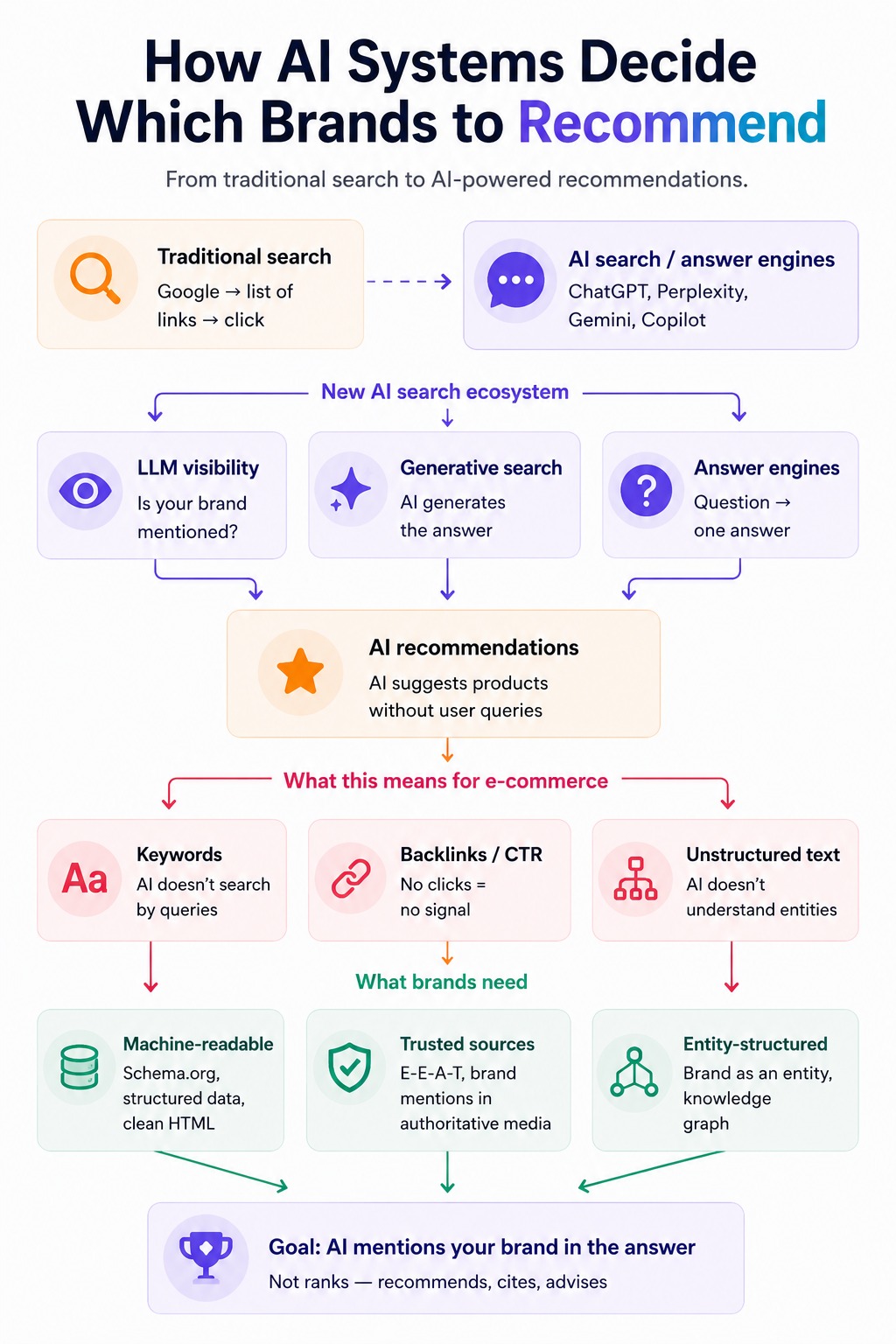
AI is changing how customers discover products and make purchasing decisions.
For ecommerce brands, visibility is no longer determined solely by rankings. Increasingly, it depends on whether AI systems understand, trust and recommend your brand.
Being found still matters. Being recommended matters more.
Product discovery is becoming more conversational.
Instead of comparing dozens of search results, users can ask a detailed question and receive a curated recommendation from an AI system.
As AI becomes part of the buying journey, customers increasingly move from discovery to decision within a conversation rather than through multiple website visits.
For ecommerce brands, the implication is clear: visibility is no longer determined solely by rankings. It increasingly depends on whether AI systems recommend your products and brand.
The trend is clear: AI is no longer an emerging technology. It's rapidly becoming part of how customers discover products, evaluate brands and make purchasing decisions.
Traditional ecommerce discovery relied on research:
Search → Results → Product Pages → Reviews → Purchase
AI-assisted discovery increasingly relies on recommendations:
Question → Recommendation → Validation → Purchase
As AI helps users evaluate options earlier in the buying journey, brands have fewer opportunities to influence consideration.
The brands included in recommendations gain an advantage before the first website visit ever happens.
Competition in ecommerce has been intensifying for years. Organic visibility is becoming harder to earn as search results are increasingly dominated by large marketplaces, major publishers and established brands.
In 2025, Amazon alone represented approximately 37.6% of U.S. ecommerce sales, highlighting how concentrated digital commerce has become. At the same time, Google continues to favour highly authoritative domains for many commercial queries, leaving less room for emerging brands to compete organically.
AI is adding a new layer to this challenge. Brands are no longer competing solely for rankings — they are competing for inclusion in recommendations.
Every AI-generated answer effectively creates a shortlist. A user searching for the best ergonomic office chair may receive three recommendations, not thirty. That limited visibility makes AI platforms increasingly influential in shaping which brands enter the consideration set.
The question is no longer just "Can we rank?" It's "Will AI recommend us?"
Historically, search engines helped users discover options. AI systems increasingly help users evaluate them.
This distinction matters because recommendations influence perception. When a brand appears consistently across AI-generated answers, it gains familiarity, credibility and trust before a customer even visits a website.
As AI adoption grows, recommendation visibility is becoming a competitive advantage in its own right.
One of the biggest misconceptions about AI visibility is that it depends solely on content quality. While content remains important, AI systems also need clear signals that help them understand who a brand is, what it sells and why it is relevant.
Unlike humans, AI systems cannot rely on design, visuals or user experience to interpret information. They depend on structured, consistent and machine-readable data to understand products, categories, attributes and brand relationships.
The easier a brand is to understand, the more likely it is to be discovered, referenced and recommended.
Imagine two ecommerce websites selling similar products.
One provides clear product information, structured data, consistent branding and well-organised content. The other relies on duplicate descriptions, weak site architecture and limited structured information.
To a customer, both businesses may appear equally credible. To an AI system, one is significantly easier to understand.
And what AI understands, it is more likely to recommend.
Many brands focus heavily on traffic acquisition while overlooking discoverability.
The two are not the same. Traffic measures whether users arrive. Discoverability determines whether AI systems can find, interpret and trust information in the first place.
Weak product data, inconsistent brand information, missing structured data and thin category content all make it harder for AI systems to build confidence.
Without confidence, recommendation becomes less likely.
Most ecommerce brands are still optimising primarily for traditional search. As a result, AI visibility remains a relatively underdeveloped competitive channel.
For brands that act early, this creates an opportunity to establish stronger recommendation visibility before AI-powered discovery becomes as crowded as traditional SEO.
The goal isn't just to be found. It's to be recommended.
[Insert Infographic: Why AI SEO Matters for Ecommerce Brands]
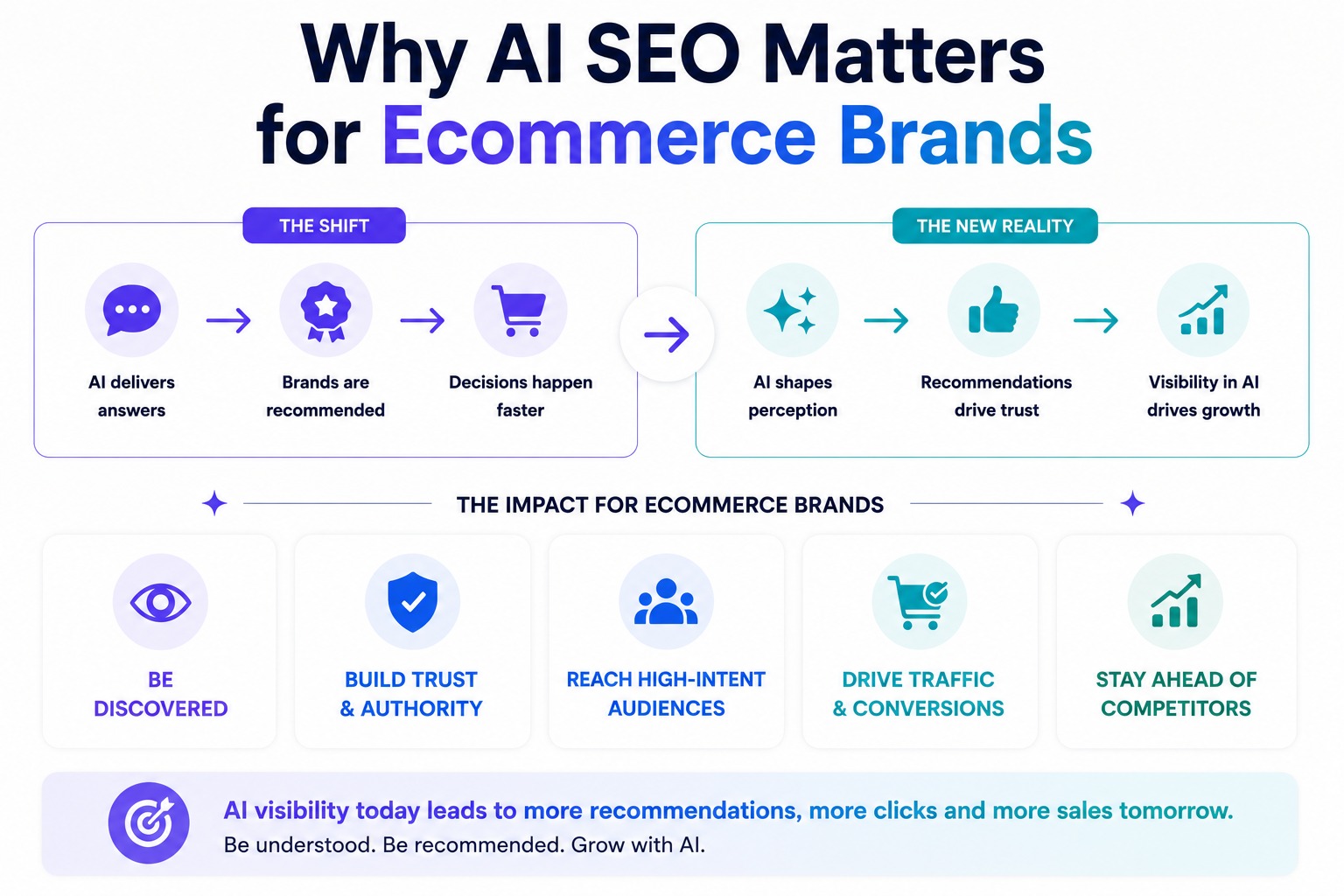
Before a brand can be recommended, it first needs to be understood.
Unlike traditional search engines, AI systems don't simply match keywords to pages. They build an understanding of brands, products and topics using entities, relationships, trust signals and structured information.
This is where many ecommerce brands underestimate the challenge. Humans can interpret a website through design, visuals and experience. AI systems rely on something different: structure, context and confidence in the information they consume.
AI doesn't read websites like humans do. It interprets signals.
At the core of modern AI search are entities — clearly identifiable things such as brands, products, categories, manufacturers, locations and product attributes.
When someone asks:
"What are the best ergonomic office chairs for remote work?"
AI doesn't simply look for matching keywords. It tries to understand which brands, products and attributes are most relevant to that request.
The clearer these relationships are, the easier it becomes for AI systems to identify relevant recommendations.
This is why AI visibility increasingly depends on entities, not just keywords.
Entities are only part of the picture. AI systems also evaluate how those entities connect to one another.
These connections, known as semantic relationships, help AI understand whether a brand is genuinely relevant to a topic or category.
For example, a company selling premium coffee equipment would naturally be associated with topics such as espresso machines, coffee grinders, brewing methods and home coffee setups. The stronger and more consistent those relationships are, the easier it becomes for AI to understand the brand's expertise.
The broader and more connected your topical coverage, the stronger your relevance signals become.
Structured data helps AI systems interpret information with greater confidence. Instead of inferring meaning from content alone, AI can rely on explicit signals about products, reviews, FAQs, organisations and other key elements.
The clearer the structure, the easier it becomes for AI systems to understand and reference your content.
AI systems evaluate expertise across topics, not individual pages.
Brands that consistently cover a subject through guides, comparisons, reviews and educational content create stronger relevance signals than brands with isolated content.
The goal is not more content. It's deeper topical coverage.
AI systems are more likely to recommend brands they perceive as credible.
Industry recognition, editorial mentions, expert content, authoritative backlinks and independent references all contribute to that perception.
The stronger and more consistent the trust signals, the greater the likelihood of recommendation.
AI systems don't evaluate individual pages in isolation. They build a broader understanding of a brand using entities, relationships, structured data, trust signals, reputation and information from multiple sources.
The stronger and more consistent those signals are, the easier it becomes for AI systems to understand what a brand does, who it serves and why it should be recommended.
Before AI can recommend a brand, it first needs to understand it.
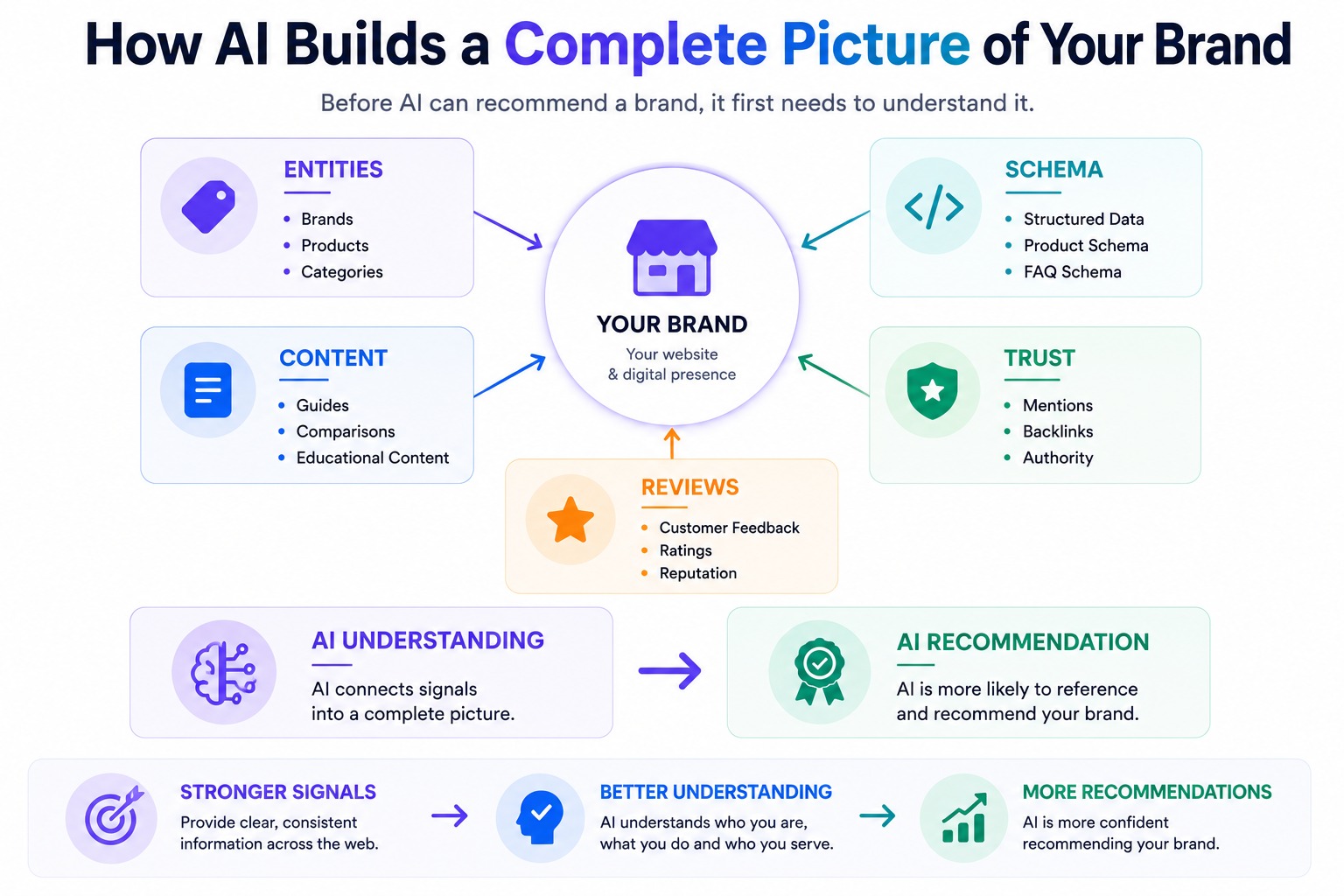
While traditional SEO and AI SEO are closely connected, they optimise for different outcomes. Traditional search engines aim to rank pages. AI systems aim to generate answers and recommendations.
The difference may seem subtle, but it changes how brands earn visibility.
Traditional SEO helps users find your website. AI SEO helps AI systems understand when your brand should be part of the answer.
Understanding how AI systems work is only the first step. The next challenge is turning that understanding into action.
Successful AI SEO is not built on a single tactic. It comes from combining the signals that help AI systems understand, trust and recommend your brand.
The five strategies below form the foundation of AI visibility for ecommerce brands.
One of the biggest shifts in modern search is the move from keywords to entities. Keywords help search engines understand what a page is about. Entities help AI systems understand what something actually is.
For ecommerce businesses, key entities include:
Consider two product pages. One focuses primarily on keywords. The other clearly defines the product, its attributes, related categories, intended audience and relationship to other products. The second page provides significantly more context.
And context is what AI systems rely on when generating recommendations.
Entity SEO is not simply about identifying products. It's about creating relationships between them.
AI systems increasingly look for connections such as:
These relationships help build a clearer understanding of where your business fits within a market. The stronger those relationships become, the more likely AI is to associate your brand with relevant customer needs.
AI systems rely on relationships between brands, products, categories and attributes. The stronger those connections become, the easier it is for AI to understand where your business fits within a market.
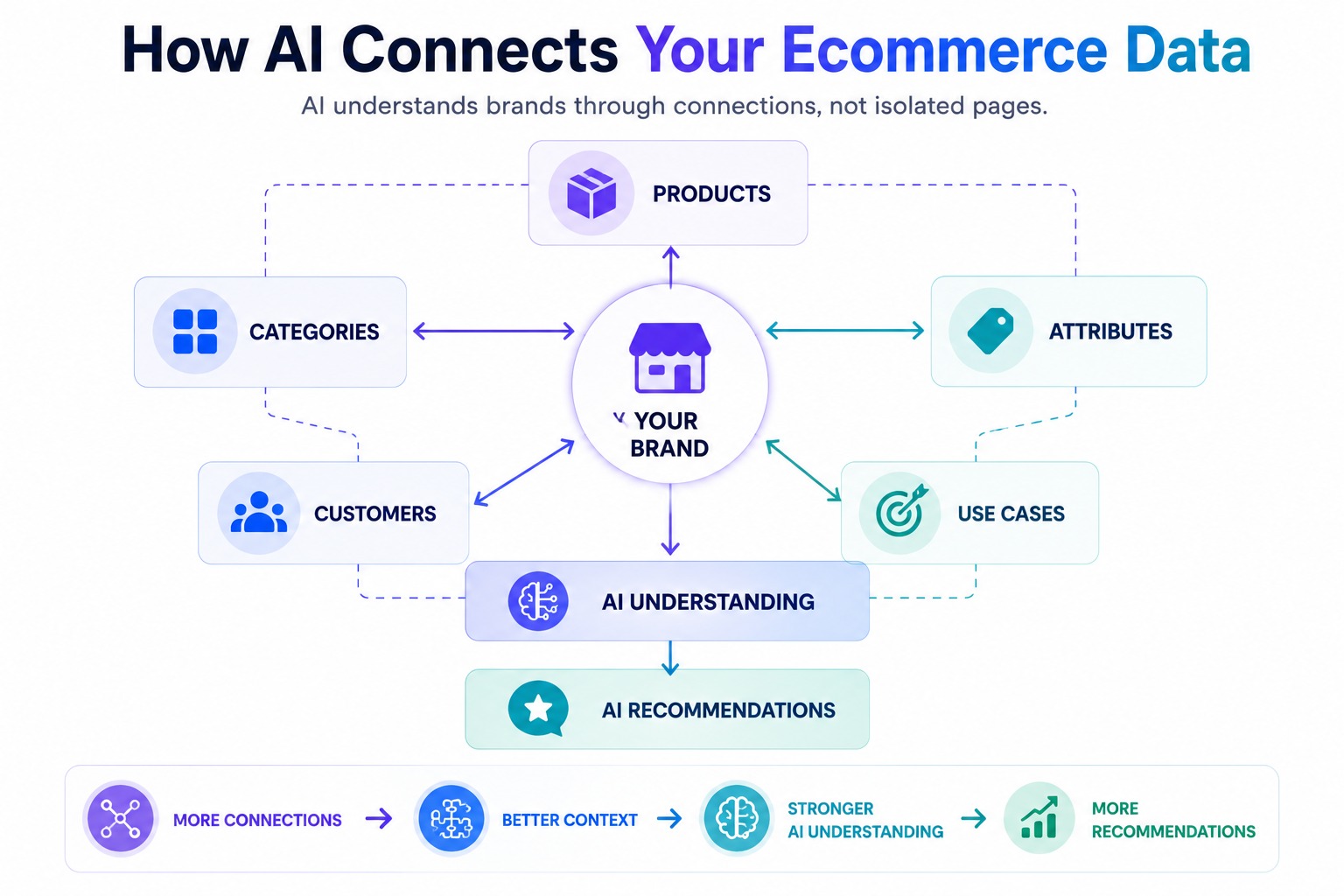
Structured data helps AI systems interpret information with greater confidence. Instead of relying on inference, AI can use explicit signals about products, reviews, FAQs, organisations and site structure.
For ecommerce brands, the most important schema types include:
The clearer your data is structured, the easier it becomes for AI systems to understand and reference it.
Product schema helps AI understand:
Without structured product information, important context can be lost.
Reviews provide valuable trust signals. Review schema makes those signals easier for machines to interpret and reference.
Well-structured FAQs help answer common customer questions directly. They also create content that AI systems can easily extract and reference.
Organisation schema provides context about the business itself. It helps AI connect products to a clearly defined company entity.
Breadcrumb schema strengthens contextual understanding. It helps AI understand how products, categories and content relate to one another. This reinforces semantic relationships throughout the site.
Clear merchant data helps establish trust. Information about shipping, returns, support and business details contributes to credibility and transparency.
Many content strategies are still designed exclusively for traditional search engines.
Large language models evaluate content differently. Their goal is not to rank pages. Their goal is to answer questions.
This means content must be structured in ways that make information easy to understand and extract.
AI interactions are inherently conversational.
Users ask questions. Strong AI-friendly content answers them directly.
Instead of focusing solely on target keywords, focus on the questions behind those keywords.
For example:
Instead of: "Standing Desk Buying Guide" consider: "How Do You Choose the Right Standing Desk for a Home Office?"
The second format aligns more naturally with how users interact with AI.
Use clear headings, logical hierarchy and contextual explanations. AI systems reward clarity far more than complexity.
The easier content is to understand, the easier it becomes to reference and recommend.
One article rarely creates authority. Authority emerges when multiple pieces of content reinforce one another.
Strong topical clusters typically include:
Together, these assets help establish expertise across an entire subject area.
Product pages are often the most important assets on an ecommerce website. Unfortunately, they are also among the most under-optimised. Many stores still rely on manufacturer descriptions, limited specifications and minimal context.
That approach creates challenges for AI systems.
Unique descriptions provide differentiation. They help AI understand why a product matters rather than simply what it is.
The goal is not to rewrite specifications. The goal is to provide context.
Explain:
Attributes are becoming increasingly important in AI search.
Customers often ask highly specific questions.
For example: "What is the best lightweight hiking backpack for multi-day trips?"
If weight, capacity and use case are not clearly defined, the product may never be considered.
Rich attributes create stronger matching opportunities.
Specifications should not exist only as technical data. They should help customers and AI systems understand product suitability.
Comparison content supports decision-making. It also provides valuable context for AI systems.
Examples include:
These comparisons often align closely with real AI search queries.
Product-level FAQs and reviews create additional layers of information. They answer practical questions and reinforce trust signals. Both are highly valuable within AI-driven recommendation environments.
AI systems evaluate brands beyond their own websites. Mentions, citations, expert content, backlinks and social proof all help reinforce credibility.
Focus on building consistent trust signals across the web rather than relying solely on on-site optimisation.
The stronger your authority, the stronger your recommendation potential.
Together, these strategies help AI systems answer a simple question:
"Can I confidently recommend this brand?"
The brands that make that answer easy are more likely to earn visibility in AI-powered search and recommendation systems.
[Insert Infographic: Core AI SEO Strategies for Ecommerce Websites]
As AI visibility becomes a growing priority, many ecommerce brands assume they need entirely new optimisation tactics.
In reality, most AI visibility problems stem from familiar issues: weak structure, unclear signals and limited authority.
The most common mistakes include:
Using the same product descriptions as every other retailer makes it difficult for AI systems to identify expertise or differentiation.
Missing or incomplete schema reduces clarity and makes products harder for AI systems to interpret.
Content that repeats existing information rarely becomes a trusted source or influences recommendations.
Unclear relationships between products, categories and content make it harder for AI systems to understand your business.
Conflicting information across websites, directories and social platforms creates uncertainty and weakens trust.
Category pages without supporting content provide little context about customer needs, use cases or buying decisions.
Strong rankings do not guarantee AI visibility. AI systems evaluate trust, authority and understanding—not just position in search results.
Most of these issues reduce one thing: confidence.
If AI systems cannot clearly understand your brand, products and expertise, they are less likely to recommend them.
Stay ahead with the latest marketing trends and growth strategies.