CMS Migration Trends 2026: AI-Enabled Platforms for Businesses, E-Commerce, and Media Portals
This article explores how businesses in 2026 are moving away from traditional CMS platforms toward modern, AI-enabled, headless, and cloud-based solutions to improve performance, scalability, and digital experiences.
Admin MBD
March 23, 2026
Next‑Gen Websites 2026: How Corporate Sites, E‑Commerce, and News Portals Are Adopting AI‑Ready CMS
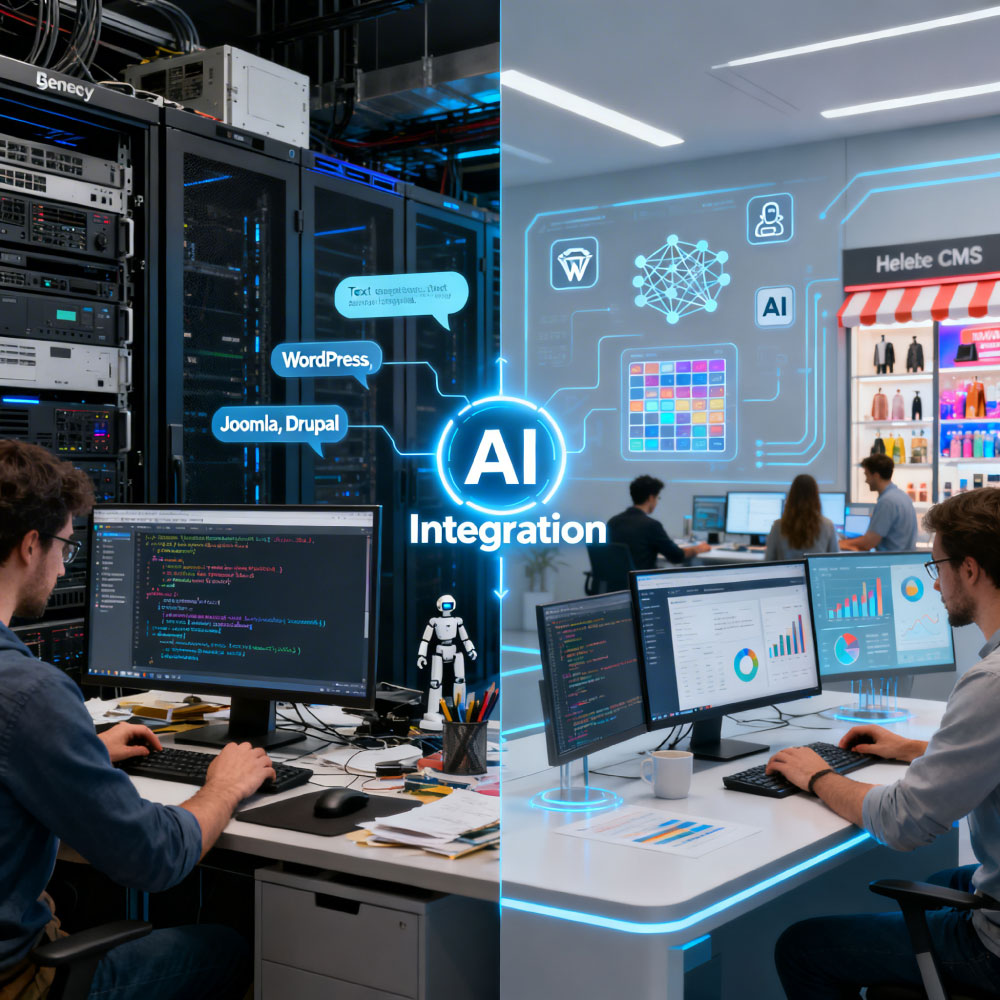
In 2026, digital transformation continues to reshape how companies build and manage online experiences. Many organizations are actively re‑evaluating their digital infrastructure, and traditional content management systems (CMS) such as WordPress, Joomla, and Drupal are increasingly considered bottlenecks for large, performance‑critical projects.
Challenges of Traditional CMS
Although legacy CMS platforms were foundational in the early web era, they now face several limitations in the context of modern business needs:
Security risks from outdated plugins and architectures – Long‑tail dependencies and legacy code increase vulnerability risks and ongoing maintenance costs.
Scaling and maintenance difficulties – Handling large enterprise sites with complex data and traffic often requires extensive custom development and optimization.
Limited extensibility and integrations – Classic systems can struggle to integrate seamlessly with modern digital services, microservices, or external APIs without significant custom engineering.
Performance under high load – Traditional platforms were not originally designed for headless architectures or highly dynamic front ends, which can reduce speed and reliability at scale.
Why Legacy CMS Struggle with AI Integration
One of the most significant trends in 2026 is the increasing adoption of AI‑powered tools for content automation, SEO optimization, media tagging, personalization, and analytics. Modern platforms are designed with AI integration at their core — enabling workflows such as:
Automated content generation
AI‑driven metadata and tagging
Smart recommendations and UX personalization
Predictive analytics and workflow automation
By contrast, many traditional CMS setups lack built‑in AI capabilities and cannot easily integrate next‑generation AI services without extensive customization. This gap makes legacy systems less competitive in terms of efficiency and automation.
Business Implications
Because of these challenges, companies that remain on older CMS platforms risk falling behind in terms of:
Speed of feature delivery and innovation
User experience quality
Operational efficiency and automation
Future‑proofing digital infrastructure
Modern CMS platforms — whether headless, cloud‑native, or AI‑enhanced — offer greater flexibility, better performance, and deeper integration with advanced tools, positioning them as the strategic choice for organizations that need to compete in a digital‑first economy.
Headless CMS and Hybrid Platforms — the Standard of 2026
In 2026, traditional monolithic CMS platforms are increasingly being replaced by headless and hybrid CMS solutions such as Strapi, Contentful, Sanity and modern e‑commerce frameworks like Shopify Hydrogen. These platforms are rapidly becoming the industry standard for corporate websites, e‑commerce stores and large digital experiences.
Key Advantages of Headless and Hybrid Platforms
Separation of frontend and backend Content is managed independently from its presentation layer. Developers can use any frontend stack (e.g., React, Vue, Next.js) to build rich, interactive user interfaces without being tied to the CMS’s templating system.
High performance and scalability Because content is delivered via APIs, headless architectures significantly reduce server load and enable faster page delivery — often through CDN caching or edge networks — resulting in better performance for global audiences.
Flexible integrations with modern services Headless and hybrid platforms are designed to integrate smoothly with contemporary tech ecosystems, including CRM, marketing automation platforms, analytics, PIM (Product Information Management) and ERP systems. This allows businesses to unify their digital stack and automate workflows more effectively.
Omnichannel content delivery Because content isn’t bound to a single presentation layer, it can be distributed consistently across websites, mobile apps, digital kiosks, email campaigns, voice interfaces and IoT devices — all from the same backend.
AI‑support and content automation Modern platforms increasingly incorporate AI‑powered capabilities or are built to integrate with AI services. These include automated content generation, semantic tagging, UX/UI recommendations and personalization — enabling teams to reduce manual tasks and optimize digital experiences at scale.
Why These Platforms Matter in 2026: Headless and hybrid CMS solutions help businesses launch projects faster and more efficiently, while maintaining flexibility, performance and future‑proof scalability. Because these platforms were designed with modern development paradigms and API‑first architectures, they are far better suited to today’s digital demands — especially for enterprises that need to deliver experiences across multiple devices and markets.
E-Commerce Is Moving Toward Custom Platforms in 2026
In 2026, online retail continues to evolve rapidly, and many established brands and retailers are choosing more flexible, scalable e‑commerce platforms that better align with modern business needs — from performance and customization to AI‑enhanced operations and omnichannel selling.
According to industry usage data, platforms like Shopify continue to gain share due to their ease of use and rapid innovation, while others like BigCommerce are steadily growing in the mid‑market segment and enterprise space. (turn0search0)
Leading Platforms and Why Brands Choose Them
Shopify — continues to be one of the most widely adopted e‑commerce solutions worldwide, with support for both traditional and headless commerce workflows through frameworks like Hydrogen. It powers millions of online stores and supports rapid scaling, multi‑channel selling, and expanding global operations with minimal technical overhead.
Magento / Adobe Commerce — a highly customizable enterprise‑grade platform ideal for complex e‑commerce use cases, including large catalogs, B2B capabilities, and deep integration with external systems such as ERP and content platforms. Its cloud‑native versions maintain flexibility for global operations and tailored workflows.
BigCommerce (Commerce) — an open SaaS platform with solid headless commerce support and scalable features for mid‑sized and growing stores. It enables multi‑channel selling and strong performance out of the box, and is increasingly chosen by brands that want API‑first flexibility without heavy infrastructure cost.
AI in E‑Commerce: A Game Changer
In 2026, the adoption of AI tools across e‑commerce workflows is no longer a future trend — it’s an active part of how online businesses operate:
Automated product description generation — saving time and improving consistency across catalogs.
Personalized product recommendations — increasing average order values and conversion rates.
AI‑powered marketing automation — optimizing campaigns and customer journeys at scale.
Demand forecasting and supply automation — enabling smarter inventory planning and logistics.
Platforms like Shopify are pushing deeper into integrated AI automation, including tools that can rapidly build complete storefronts from simple inputs, reflecting a broader push toward AI‑assisted commerce.
Summary: Where E-Commerce Platforms Stand in 2026
Platform
Best For
Key Strengths
Shopify / Shopify Plus
Rapid growth, multi-channel selling
Easy setup, fast scaling, headless options
Magento / Adobe Commerce
Complex enterprise operations
Deep customization and third-party integrations
BigCommerce (Commerce)
Mid-market & scalable storefronts
Strong API/Headless support, multi-channel
Other platforms (e.g., WooCommerce, Shopware)
Flexible tech stacks
Open-source control and cost advantages
Key takeaway: E‑commerce in 2026 is defined by flexibility, performance, and intelligent automation. While legacy platforms still power many stores, businesses increasingly choose platforms like Shopify, BigCommerce, and Adobe Commerce for their scalability, extensibility, and support for modern workflows — including AI integration and headless commerce.
Landing Pages and Visual Website Builders with AI — Webflow as the Core Solution
In 2026, no-code and visual website builders have become essential tools for creating high-quality landing pages, corporate websites, and marketing microsites without deep technical expertise. Among these, Webflow stands out as the leading platform, combining a powerful visual editor with fully integrated AI-driven workflows that streamline both design and content creation. While other platforms like Tilda, Framer, Wix, and Squarespace remain popular for smaller projects, Webflow offers unmatched flexibility and scalability for professional teams and enterprise-level websites.
Core AI Capabilities in Webflow
Webflow integrates artificial intelligence directly into its platform, enabling teams to optimize major aspects of website creation:
Automated Content Generation
AI assists in generating headlines, text blocks, and page copy based on user input or project objectives.
This reduces manual content creation time while maintaining consistency and relevance across pages. (webflow.com/blog/ai-in-webflow)
Design and UX Optimization
AI analyzes page layouts to provide recommendations on spacing, structure, and user experience.
Designers can create more intuitive, visually appealing, and conversion-oriented pages without trial-and-error iterations.
Visual Asset Creation
Webflow’s AI can generate images, icons, and other visual components directly in the editor.
This eliminates the need for external design tools, enabling faster prototyping and production.
Unified AI-Enhanced Workflow
Unlike legacy CMS platforms, Webflow’s AI is built-in and fully integrated, allowing teams to manage content, design, and layout in a single environment.
No custom coding or third-party plugins are required, which simplifies maintenance and accelerates project delivery.
Why Webflow Is Becoming the Platform of Choice
Webflow’s popularity stems from its combination of flexible design tools, CMS functionality, and AI-powered automation, empowering teams to:
Launch landing pages and microsites rapidly with AI-generated content, visuals, and layouts.
Prototype and iterate designs in real time, without switching between multiple applications.
Manage and scale websites efficiently, even for large corporate projects, with minimal technical overhead.
By centralizing design, content management, and AI-assisted optimization, Webflow allows businesses to reduce time-to-market, experiment with ideas quickly, and deliver superior user experiences — all without relying on full-time developers.
Website Migration Trends by Site Type in 2026
As businesses modernize their digital infrastructure in 2026, many are moving away from legacy CMS platforms toward modern, AI-ready, and headless solutions. The migration varies by type of website — corporate, e‑commerce, or news portals — based on performance, flexibility, and integration needs.
Headless CMS (API-first), Next.js / React SPA + headless backend, Webflow (for smaller media or microsites)
Key Insights
Corporate websites are moving to headless or hybrid platforms like Webflow to achieve faster load times, better scalability, and AI‑enhanced workflows for content management.
E‑commerce migration focuses on platforms that support headless commerce, AI-driven personalization, and multi-channel selling. Shopify and BigCommerce dominate in adoption for brands seeking scalable, automated solutions.
News and media portals increasingly use headless CMS or modern front-end frameworks (Next.js, React) to improve speed, enable omnichannel distribution, and simplify integration with analytics and AI tools.
These trends indicate that legacy CMS platforms are becoming bottlenecks, while modern solutions provide flexibility, AI integration, and improved user experience, making them the preferred choice for businesses in 2026.
Website Categories and Migration Trends 2026
In 2026, businesses continue to migrate from legacy CMS to modern AI‑ready, headless, and visual platforms. Migration patterns differ by site type — corporate websites, e‑commerce, and news portals — reflecting needs for flexibility, scalability, and automation.
Corporate Websites
Platform / Type
Approx. Market Share 2026
Migration Trend
WordPress (traditional)
~43%
Partially replaced by headless CMS and visual builders such as Webflow
Drupal
~1.8%
Migrating to headless architectures and modern CMS solutions
Joomla
~2.6%
Declining in popularity; companies move to more flexible platforms
TYPO3 / Proprietary CMS
small share
Gradual decline; migration toward headless and enterprise CMS
While many large corporate sites remain on WordPress, a growing number are moving to headless CMS or modern visual platforms to gain flexibility, speed, and AI-optimized workflows.
E-Commerce (Online Stores)
Platform
Approx. Share in E-Commerce 2026
Notes
WooCommerce (WordPress)
~23%
Largest self-hosted segment
Shopify
~28%
Leading SaaS e-commerce platform; main destination for migrations from older platforms
Magento / Adobe Commerce
~8%
Enterprise use persists, but losing market share
Wix / Squarespace e-commerce
~4.7% / ~3–5%
Growing among SMB stores
BigCommerce & other headless platforms
~3%
Growth due to headless commerce adoption
Migration in e‑commerce often moves stores from WooCommerce or Magento to Shopify, BigCommerce, and headless platforms, especially when speed, scalability, and AI integration are key.
Information / News Portals
Platform
Usage 2026
Migration Trend
WordPress
~40–45% of all sites (including blogs & media)
Widely used, but some migrate to modern headless stacks
Drupal
Used by large media and government portals
Partial migration to headless architectures; some remain on Drupal
Proprietary news CMS
Previously used by major publishers
Declining; migrating to WordPress VIP or headless CMS
Major media companies are moving from old proprietary systems to WordPress VIP or headless architectures, reflecting the broader trend of migrating from legacy CMS to modern solutions.
Summary Table: Migration Estimates by Site Category 2026
Site Category
% on Legacy Platforms
% on Modern Platforms
Typical Migration Paths
Corporate Websites
~68–75%
~25–32%
WordPress / Drupal / Joomla → Headless CMS, Webflow, modern static + API delivery
WordPress / Drupal → Headless API + modern front-end, WordPress VIP
Numbers are approximate, based on general CMS market distribution and observed migration trends in 2026.
Main Points
Corporate websites are gradually moving from legacy CMS to headless CMS, visual builders, and static sites with API delivery.
E‑commerce migrations are accelerating: SaaS platforms (Shopify) and headless commerce solutions are replacing traditional self-hosted CMS.
Information and news portals are adopting modern architectures: large publishers prefer headless CMS or WordPress VIP for flexibility, scalability, and integration with AI tools, while legacy news CMS are being phased out.
Migration as a Strategic Process
Moving to a new CMS, headless platform, or AI-powered solution is more than a technical update — it is a strategic business decision. Successful migration involves several key steps:
Content and Site Structure Audit- Review and optimize existing content for SEO, usability, and relevance before migration.
Integration Planning - Map out connections with CRM, ERP, analytics, and marketing tools to ensure seamless data flow.
Step-by-Step Data Migration - Transfer content and assets without losing information or search engine rankings.
AI-Enhanced UX/UI Optimization - Test speed, usability, and personalization across all devices to improve engagement and conversions.
Companies that approach migration systematically gain speed, flexibility, and a competitive edge.
Summary
In 2026, companies migrating from legacy CMS to headless or modern AI-enabled platforms achieve:
Faster site development and scaling — AI assists in design, content generation, and deployment.
Greater flexibility in customization and integrations — easily adapt to evolving business needs.
Labor optimization through AI — reduce manual work in content creation, testing, and UX adjustments.
Enhanced user experience and conversion potential — deliver personalized, responsive, and interactive experiences.
Legacy CMS without AI integration increasingly become bottlenecks, while modern platforms are setting the standard for the digital business of the future.
Migration is not just about technology — it’s an opportunity to rethink strategy, improve UX, and unlock new growth channels.
MBD Recommendation
1. For corporate websites, landing pages, portfolios, marketing microsites, or information portals, we recommend Webflow. It combines:
A visual drag-and-drop editor,
Built-in CMS,
Headless capabilities,
Easy integration with AI tools, enabling faster development and deployment.
Alternatives for corporate and media sites : Framer — suited for interactive, design-rich sites with simple content management
2. For e-commerce stores, we recommend Shopify — a leading SaaS platform with flexible configuration, headless options, and AI-enhanced optimization.
Alternatives for e-commerce: BigCommerce — suitable for large-scale stores and omnichannel sales and Magento / Adobe Commerce — enterprise-grade solution allowing full customization of functionality.
MBD Knowledge Hub
Website Categories: How Digital Projects Are Classified
The modern web includes a wide range of websites, each designed for different purposes and audiences. Understanding the main categories of websites helps businesses choose the right digital solution for their goals — whether it is a corporate website, an online store, a portfolio, or a complex web application.
Below are the most common types of websites, their key functions, and the platforms typically used to build them.
Corporate / Business Websites
Corporate websites represent a company, brand, or organization online.
Main goals
Build credibility and trust
Provide information about the company and its services
Generate leads and new business opportunities
Typical features
About the company
Services or products
Case studies and portfolio
Blog or news section
Contact forms and CRM integrations
Personal and Portfolio Websites
Personal websites highlight an individual's professional work, skills, and achievements.
Main goals
Promote professional services
Attract clients or employers
Demonstrate experience and expertise
Typical features
Personal biography or resume
Portfolio of projects
Blog or articles
Contact form
E-Commerce Websites
E-commerce websites allow businesses to sell products or services online.
Main goals
Manage online sales
Display product catalogs
Process payments and orders
Key features
Product catalog
Shopping cart
Secure payment systems
Order processing
Marketplace integrations
Landing Pages
Landing pages are single-page websites designed to encourage a specific action.
Main goals
Lead generation
Product promotion
Event or service registration
Key elements
Clear headline and value proposition
Product or service description
Lead capture form
Strong call-to-action (CTA)
Blogs, News, and Media Websites
These websites publish regularly updated content such as articles, news, and videos.
Main goals
Inform and educate audiences
Generate traffic through search engines
Monetize through ads or subscriptions
Community and Social Platforms
These websites allow users to communicate, interact, and share information.
Typical features
User profiles
Forums and discussion groups
Community feeds
Messaging and interaction tools
Examples
Facebook
LinkedIn
Reddit
Educational and E-Learning Platforms
Educational websites provide online learning experiences, courses, and training.
Typical features
Learning Management Systems (LMS)
Video lessons
Quizzes and tests
Certificates and course progress tracking
Entertainment and Gaming Websites
These websites focus on digital entertainment, including games, streaming, and multimedia content.
Main goals
Engage and retain audiences
Monetize through subscriptions, ads, or premium content
Examples
Netflix
Twitch
Online gaming portals
Government and Non-Profit Websites
These websites provide information and services for citizens and communities.
Examples
Government portals
Educational institutions
Non-profit organizations
Typical features
Public information
Announcements and news
Document access
Online request forms
Web Applications and SaaS Platforms
Web applications allow users to perform tasks directly in a browser.
Examples include:
Google Docs
Canva
Figma
Notion
Typical features
User registration and accounts
Dashboards
Integrations with other tools
APIs and cloud collaboration
What Is a Headless CMS?
A Headless CMS (Content Management System) is a modern type of CMS that separates content management from the visual presentation of a website.
Unlike traditional CMS platforms, a headless CMS does not include a built-in front-end interface. Instead, it provides a backend system for managing content and delivers that content through APIs so developers can display it on websites, mobile apps, or other digital platforms.
What “Headless” Means
The word “head” refers to the front-end of a website — the visual interface users see.
A headless CMS removes the front-end layer, meaning the system focuses only on storing and managing content. Developers are free to use any technology they want to present that content.
How a Headless CMS Works
Content is created and edited in the CMS dashboard, including text, images, videos, or products.
The CMS provides an API (usually REST or GraphQL) that allows other systems to access this content.
Front-end developers then use technologies such as React, Vue, Next.js, or Angular to display the content on websites, mobile apps, or other digital interfaces.
Advantages of Headless CMS
Flexibility -Developers can create websites, apps, and integrations using any modern technology.
Higher performance - Because the front-end is independent, developers can optimize speed and loading times.
Scalability - One backend system can distribute content to multiple channels — websites, mobile apps, marketplaces, and more.
Easy integration with AI and other services -AI tools for content generation, personalization, and analytics can be easily integrated.
Improved security - Separating the front-end from the CMS reduces vulnerabilities related to outdated plugins.
Popular Headless CMS Platforms
Some widely used headless CMS platforms include:
Contentful — a leading enterprise platform for managing large volumes of digital content
Strapi — an open-source and highly customizable CMS
Sanity — known for real-time collaboration and flexible content structures
Prismic — often used for marketing websites and landing pages
Shopify Hydrogen and BigCommerce headless — solutions designed specifically for headless e-commerce
A headless CMS is designed for speed, flexibility, and multi-channel content delivery. It is especially suitable for corporate websites, e-commerce platforms, and media portals where performance, scalability, and integration with modern tools — including AI — are important.
Where Webflow Fits in the Website Platform Ecosystem
Webflow belongs to the category of visual website builders and no-code/low-code platforms, combining design tools with CMS functionality and partial headless capabilities.
Platform Category
Webflow is considered a visual website builder and no-code platform. It allows users to design and build professional websites through a drag-and-drop interface without requiring deep programming knowledge.
At the same time, Webflow includes a built-in CMS for managing dynamic content such as blogs, case studies, product listings, and portfolios.
Webflow is also API-friendly, which means content can be exported or integrated with external systems, making it compatible with modern headless workflows.
Common Use Cases
Webflow is widely used for:
Corporate and business websites
Marketing websites and landing pages
Portfolio sites for designers and agencies
Small to mid-size e-commerce projects
Webflow can also integrate with platforms such as Shopify or Foxy.io to support more advanced commerce functionality. It sits between simple website builders and advanced development frameworks, offering the usability of visual tools like Wix or Squarespace while providing the flexibility needed for professional marketing websites and corporate platforms.
Shopify: A Platform for E-Commerce
Shopify is a cloud-based SaaS platform designed for creating and managing online stores. It allows businesses to handle product catalogs, payments, shipping, and marketing without needing to build complex infrastructure.
The platform works well for both small businesses and large enterprises thanks to its scalability and flexible architecture.
Key Shopify Features
Drag-and-drop tools for building storefront pages
Built-in SEO and marketing features
Headless commerce support through APIs
A large ecosystem of apps and integrations
AI tools for generating product descriptions and marketing content
Reliable hosting, security, and automatic updates
Shopify Plans
Shopify offers several pricing levels designed for different types of businesses.
Shopify Starter: Designed for individual sellers and small businesses beginning online sales. It allows simple storefront creation and selling through social media and messaging platforms.
Shopify Basic: Suitable for small businesses and startups that want a full online store on their own domain. It includes essential e-commerce tools and support for managing products and payments.
Shopify (Standard): Designed for growing small and medium-sized businesses. It adds advanced reporting, analytics, and marketing features.
Shopify Advanced: Suitable for companies that are scaling rapidly. It includes deeper analytics, automation tools, and support for larger teams.
Shopify Plus: An enterprise-level solution designed for large companies. It supports millions of orders, extensive customization, integrations with ERP and CRM systems, and advanced API capabilities. Enterprise pricing for Shopify Plus typically starts around $2,000 per month.
Shopify has become one of the most successful e-commerce platforms because it combines simplicity, scalability, reliability, and a strong ecosystem of integrations, including modern AI tools.
Depending on business needs, companies may also consider alternatives such as BigCommerce, Magento / Adobe Commerce, WooCommerce, or Shopware.
MBD blog
Latest Insights
Stay ahead with the latest marketing trends and growth strategies.